When the TV package starts to look unnecessary: Why operators need aggregation?
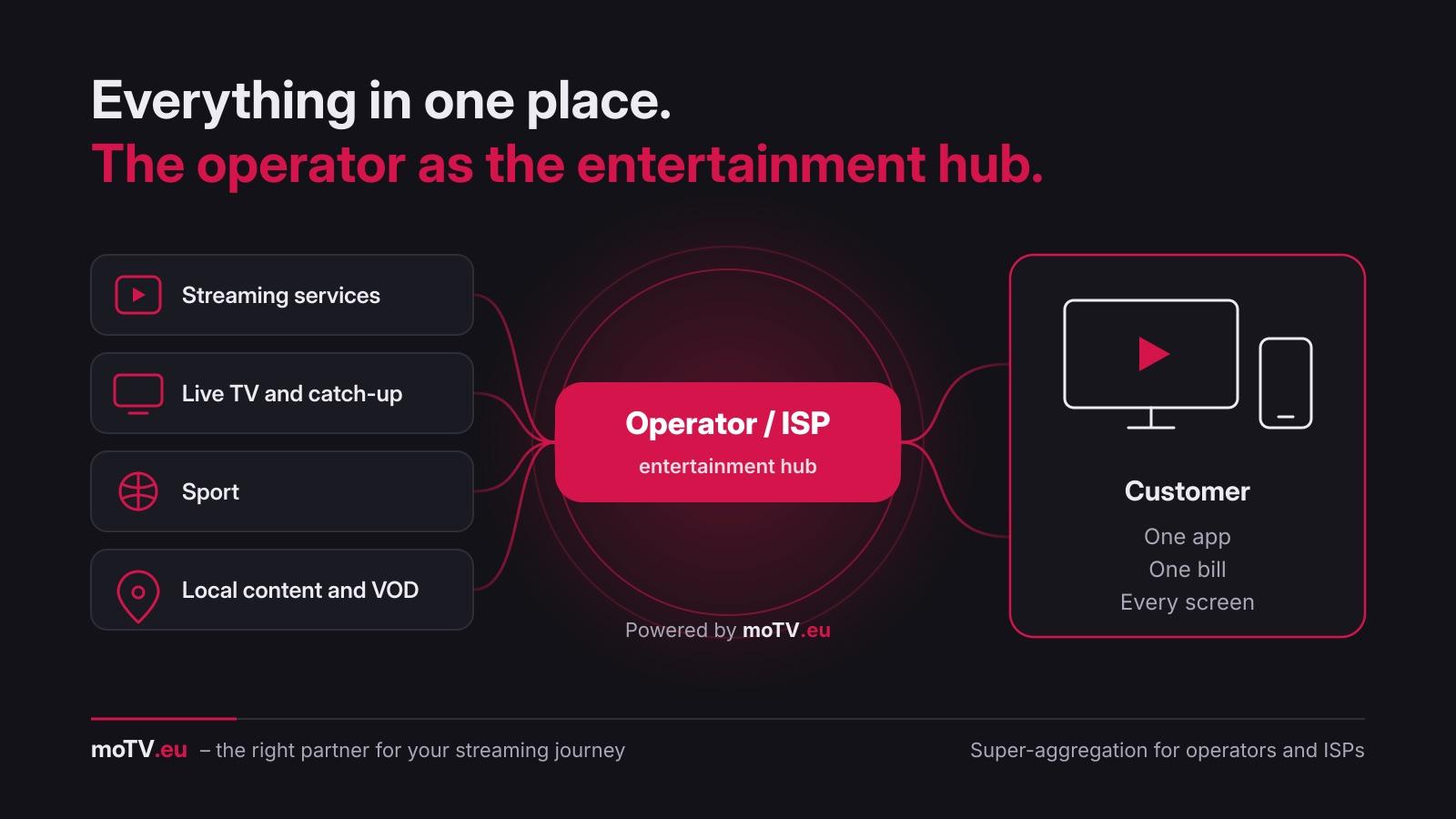
Our experience is clear: an operator that competes with Netflix and other streaming services loses. An operator that packages them into its own offer becomes the entertainment hub of the whole household. Aggregation is today one of the most effective tools against subscription fatigue, for stabilising revenue and extending customer lifetime value. The race to become the super-aggregator has begun. In this article we share what, in our experience, decides it.
Why now
Streaming prices are rising and households are tired of the number of subscriptions, apps and bills. But people are not leaving streaming: they switch services, move to cheaper tiers or choose bundles.
The data confirm the shift: according to Antenna, 27% of premium streaming subscriptions were part of a bundle in Q4 2025, up from just 14% two years earlier. Customers don’t want to choose between TV and streaming. They want both, but in one place.
What aggregation brings to the operator
- Lower churn. According to Parks Associates, 33% of pay TV subscribers stay precisely because one platform brings together the content they want. Analysys Mason found that customers who buy streaming through their operator are more satisfied and churn less than those who buy directly.
- More stable revenue and higher ARPU. Streaming services can be sold as add-ons or as part of higher-tier packages. Brazil’s Vivo reports that a complete digital bundle increases ARPU and reduces churn.
- Ownership of the customer relationship. Whoever owns the bill and the main screen owns the customer.
Examples already work. One European operator launched a streaming marketplace for nearly 2 million customers across TV, web and retail stores. A South American telco became, in 2026, the first in its country to offer Netflix as a customer benefit, alongside Disney+, HBO Max and Prime Video.
From our practice
With the operators we work with, three situations keep coming up:
- The operator has a great network but an outdated TV experience. Customers pay for streaming services separately and gradually cancel their TV package, because next to them it feels expensive and less convenient. The solution is not a new network but a new digital layer on top of it.
- The operator wants to offer Netflix or other services, but every integration is a separate project. If the platform doesn’t have integrations ready, one partnership turns into months of development.
- A small operator lacks the leverage to negotiate with major studios. This is where content intermediaries such as Vubiquity help, as they already have the agreements in place.
A typical example from practice: a regional fibre internet provider offered traditional TV via set-top boxes and watched customers gradually cancel their TV packages and keep only internet. Instead of replacing its infrastructure, it deployed a platform that brought live TV, catch-up, VOD and third-party streaming services together in one app for TVs and mobiles, with a single bill. Customers no longer have to work out what’s on where, and the operator has a reason for them to stay and pay more.
A row of icons on the screen is not enough
Super-aggregation only works when the customer truly feels the difference. Any smart TV can show app icons on its home screen. An operator needs more:
- A unified interface where live TV, catch-up, VOD and streaming services live side by side.
- Search and recommendations across services, so customers don’t need to know what’s on where.
- One bill and subscription management, with one-click service activation.
- Ready-made third-party integrations, so that each new service doesn’t mean months of development.
This is where it is decided who owns the customer. If the operator fails at aggregation, the TV manufacturer or a global platform will take over that role, and the operator will be left as just a connectivity provider.
moTV.eu: your path to super-aggregation
At moTV.eu we build a complete IPTV/OTT/Hybrid ecosystem that turns an operator into the household’s entertainment hub. Our platform can integrate Netflix, content via Vubiquity and other third-party services, all in one interface alongside live TV, catch-up and VOD.
- Middleware and subscription management for packages, billing and service activation.
- Apps for TVs, set-top boxes and mobiles with a unified experience.
- Open API for connecting further partners, local OTT services and your own content.
- Integrated advertising and DRM for monetisation and content protection.
- Deployment on existing infrastructure, without starting from scratch.
The race for the super-aggregator role has already begun. It will be won by whoever offers customers everything in one place, with one bill and no hassle. Want to be that hub? Get in touch.