The Streaming Era Is Putting Pressure on Pay TV in Latin America.
The Latin American television market is changing
For pay-TV operators, the question is no longer simply whether their network works reliably and whether the signal reaches the customer. Increasingly, what matters is the experience customers get when using the service and whether that experience can compete with platforms such as Netflix, YouTube, Disney+ and other streaming services.
According to S&P Global Market Intelligence, pay-TV penetration in Latin America and the Caribbean fell from 42% of households in 2016 to 31% in 2024, largely driven by the growth of streaming platforms. At the same time, the structure of the market is changing: fiber-based IPTV grew from just 1.3% of the pay-TV market in 2014 to 21.5% in 2024.
These figures point to an important trend. Consumers are not simply abandoning television. They are changing the way they expect to access, discover and consume TV content.
The network may still work. The customer experience needs to evolve.
Many regional operators have valuable infrastructure, an established customer base and relationships built over many years. The challenge, therefore, is not necessarily the network itself.
Increasingly, the challenge lies in the customer experience layer that users interact with every day.
Consumers are accustomed to fast search, personalized recommendations, intuitive interfaces, access to content across multiple devices and the ability to continue watching from where they left off.
Television is no longer evaluated solely by the number of channels available. Ease of use, speed of content discovery and the overall user experience are also becoming part of the value customers associate with a TV service.
Publicly available industry sources also point to the growing importance of user experience and content discovery for pay-TV operators in Latin America. One frequently cited finding is that 83% of Latin American households consume television while using a second screen, such as a smartphone or tablet.
This changes the way operators need to think about their television services.
Modernization does not mean starting from scratch
One of the biggest misconceptions is that modernizing a television platform necessarily means replacing the entire existing infrastructure.
It does not.
Operators can use their existing networks and investments as a foundation and progressively add a new digital layer.
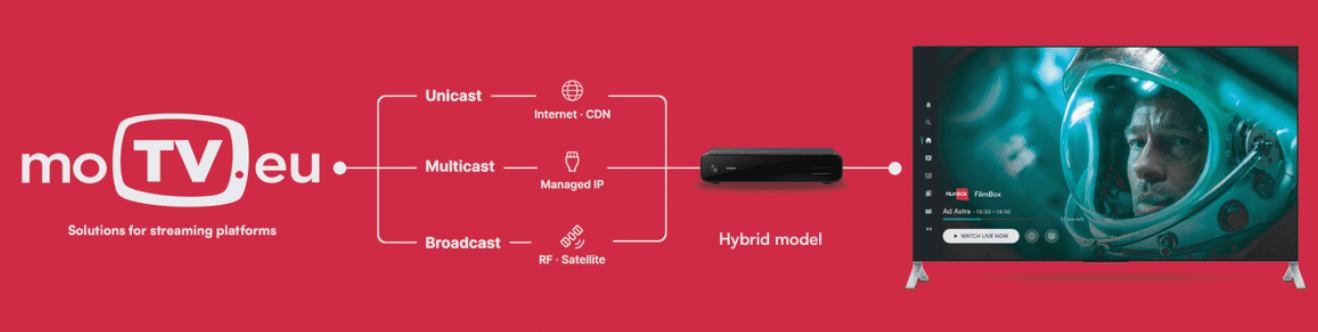
A hybrid approach can combine traditional TV distribution with OTT and IPTV technologies, offering customers:
- applications for Smart TVs, smartphones and tablets;
- a modern and intuitive user interface;
- an advanced EPG;
- content search and discovery;
- personalized recommendations;
- live television alongside on-demand content;
- access across multiple devices;
- new monetization opportunities through subscriptions, advertising and other business models.
In this way, operators do not have to abandon their existing infrastructure. They can extend it with technologies that respond to changing consumer habits.
IPTV and OTT are not simply alternatives to cable
The evolution of the market shows that this is not simply a competition between “cable” and “streaming.”
According to S&P Global Market Intelligence, while traditional pay TV continues to lose penetration across the region, IPTV is significantly increasing its market share. At the same time, high-speed broadband and FTTH networks continue to expand.
The future of television may therefore be less about replacing one technology with another and more about combining different technologies and distribution models.
For regional operators, this represents an opportunity to build on what they already have while offering customers a television experience adapted to today's digital consumption habits.
The competition is no longer only local
The competitive environment has also changed.
A regional operator is no longer competing only with another cable or IPTV provider in its city or country. It is competing for consumers' attention with global platforms that invest enormous amounts in content, technology and user experience.
This pressure is likely to continue increasing across Latin America. Amazon, for example, has announced plans to invest more than USD 2 billion in Latin America between 2027 and 2030, including investments in local content and sports rights.
For local operators, competing solely on price or the number of channels available will become increasingly difficult.
However, they have advantages that global platforms do not always have: local market knowledge, established customer relationships, their own infrastructure and the ability to combine connectivity, local content and a modern television experience.
The opportunity for regional operators
Transformation does not have to mean completely replacing the existing business model.
For many operators, the path forward may be to progressively add OTT, IPTV and application capabilities on top of the infrastructure and customer base they already have.
This allows them to evolve from a traditional television service into a digital ecosystem capable of integrating linear TV, on-demand content, applications and multiple devices.
The goal is not simply to offer more technology. It is to make the service easier to use, more attractive to consumers and more competitive with global platforms.
What we do at moTV.eu
At moTV.eu we develop a complete IPTV, OTT and Hybrid TV ecosystem for operators looking to modernize their television services without having to start from scratch.
Our solution combines technologies for content and service management, distribution, applications, user experience and different service and monetization models.
The objective is to help operators create a modern television layer around their existing strategy and infrastructure, allowing them to evolve alongside changing customer expectations.
The Latin American pay-TV market is changing. The data shows declining traditional pay-TV penetration, significant IPTV growth and increasing competition from streaming platforms.
The question, therefore, is no longer simply whether your network works.
The real question is whether the television experience you offer today meets what your customers will expect tomorrow.
If you are considering modernizing your IPTV, OTT or Hybrid TV platform while making use of the infrastructure you already have, we would be happy to explore the possibilities with you.
The key advantage of working with moTV.eu is that we provide a complete ecosystem from a single technology partner. This helps ensure reliability while avoiding the complexity and cost of integrating multiple systems from different vendors.
#IPTV #OTT #HybridTV #LatAm #PayTV #DigitalTransformation #moTV